


An impression I get from reading news is that there’s a recurring difference between the objectives of protest on the left and right.
First, though, you do have to be careful with impressions formed from consuming news media, due to the ‘news selection effect’. That is, the choices made in newsrooms of which stories to report or ignore. Not everything can be reported, so selection decisions must be made and these inevitably reflect personal sentiment in an editorial team.
When people complain about media bias, the news selection effect is probably the biggest cause. It’s often naively declared that bias in newspaper or broadcast news is a function of desiring to tell people what to think. News reporting rarely does that, though, and people mostly confuse reporting with commentary when they make that claim. Because most of us tend to have low media literacy this confusion persists. The reality is that news tends to tell you not what to think but what to care about.
I make that observation as a disclaimer ahead of these thoughts. That’s because it might be that my media choices are not reporting on the full range of protests that happen in my anglophone world, so I may well be operating on the basis of a skewed evidence sample.
With that out of the way, there seems to be a subtle difference between protest on the left and on the right. The right seems to protest against concrete things that it doesn’t like, whereas the left seems to protest against the right in general, and it seems to me to suggest quite a difference in the psychology of the two poles.
Let’s call these approaches object-directed protest and opponent-directed protest.
So I keep seeing reports of right-wing protests of the form stop this policy or development. Stop or slow immigration, repeal a fuel tax, abandon a climate measure, prevent a particular development, reverse a restriction, stop some change from continuing. The object of opposition is usually something the state is doing or proposing to do.
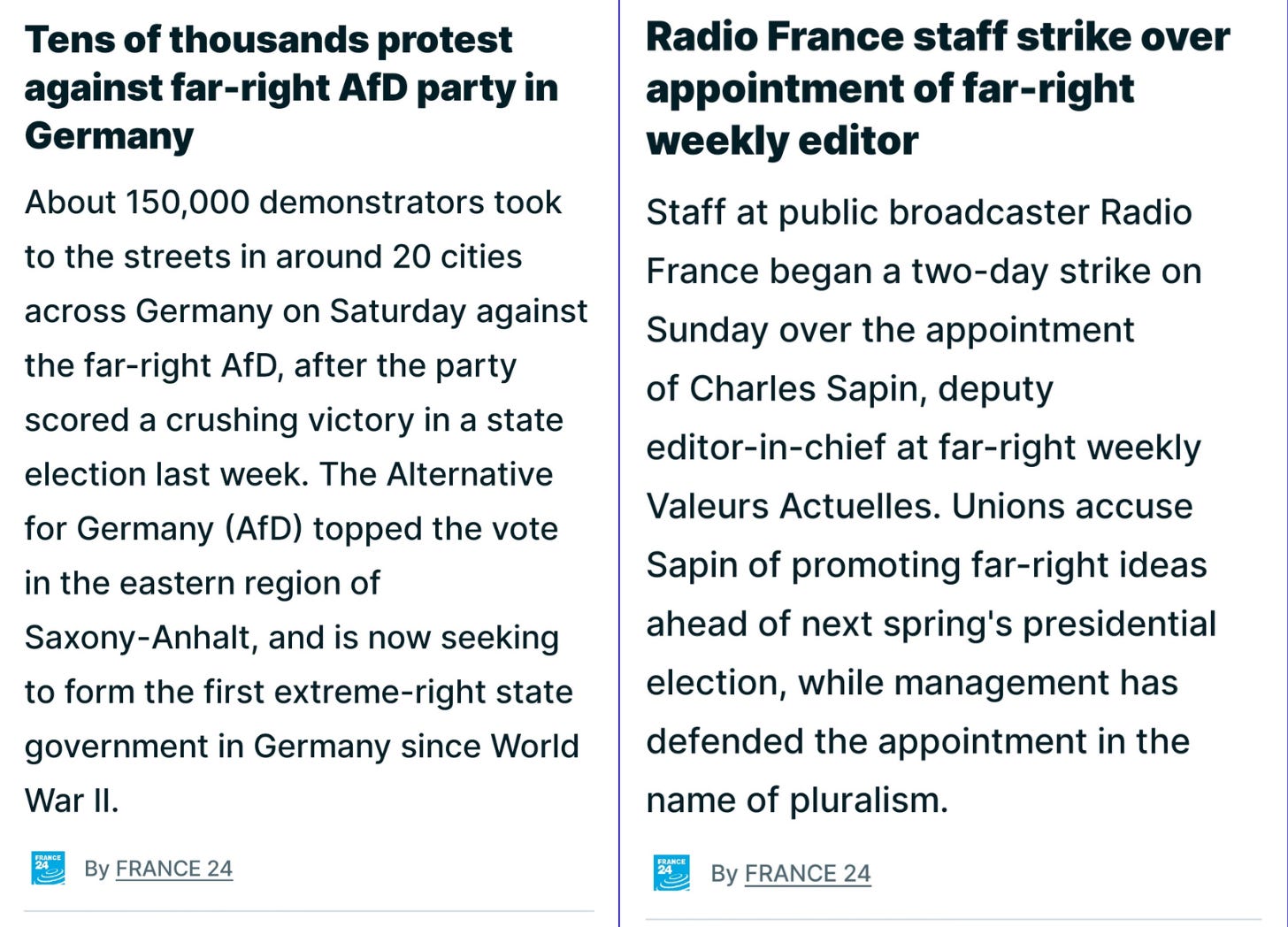
But there’s a conspicuous form of left-wing protest that takes the form these people must not prevail. Anti-AfD demonstrations in Germany are a good example. The roughly 150,000 people on the streets in Germany in that header image weren’t primarily demanding repeal of some particular AfD policy. They were demonstrating because AfD had won an election and seem to be on the way to having significant power. The political opponent itself was the object of this mobilisation.
Then I saw that a right-wing journalist had been hired by a French broadcaster and the unions went on strike in protest. Again, the object of their ire was merely the existence of a person with whom they disagree in a post they think he should not occupy.
The sense I get from these examples is that one side sees threat in terms of outcomes, such as immigration levels, tax burden, restrictions on freedom and so on. Whereas the other side seems to see threat in terms of political ideas that they don’t like. After all, the right-wing journalist had only been appointed when left-leaning staff walked out in protest. And the AfD hadn’t actually done anything either, beyond winning a lot of votes, when people mobilised to object.
It’s as if, for the leftish, opposing the political success of the other side is an end in itself. That is how you can spot the real establishment anywhere. It’s the milieu that has the most to lose when its values lose enough popular appeal.
The distinction is easily missed. One of those anti-AfD protesters would doubtless say that protesting against an incipient ethno-nationalist movement before it has even done anything is about preventing the return of Nazism, which we’d presumably all agree is a desirable guardrail to install. But they’re still protesting against what other people want, rather than a concrete policy. In Germany they call this kind of mobilisation wehrhafte Demokratie, which broadly means militant or defensive democracy. And it seems to be exactly the same principle underpinning the strike at Radio France.
The principle underlying this is that liberal democracy (as it has been increasingly embedded in many places) must be defended against change.
Incidentally, this is why I see the leftish as small c conservative. It isn’t just the right who are against change. Those days are long gone. Chances are that everyone reading this lives under a progressive liberal hegemony, whether or not they recognise it, which is why right-leaning people increasingly see themselves as incipient revolutionary upstarts, just as we on the left always did when the establishment really was quite right-wing as well as conservative.
Regular readers know my fondness for explanations rooted in personal identity and won’t be disappointed to learn that this too is how I see this type of opponent-directed protest, as opposed to policy or object-directed demonstrating.
Marching against climate change mitigation policies tends to have a concrete aim, like stop burdening me with paying for this. Whereas marching against AfD has an extra layer. As well as clearly representing anxious opposition to the possibility of a return to their horrific and shameful past I can’t shake the sense of a strong expressive and affiliative function overriding an instrumental one. After all, they’re protesting about the fact that lots of people voted for AfD rather than any policy that is currently affecting them. The same applies at Radio France.
This is something I notice all the time in political behaviour whose ostensible or instrumental purpose doesn’t adequately explain its intensity. This suggestion might break down under scrutiny, but this is not a scientific paper and my sense is that the leftish is fonder of getting together to express alarm, celebrate solidarity and make public declarations of moral identity.
This is what seemed to be going on with the No Kings protests in America earlier this year, which were very ‘in-groupy’ by dint of an over-subtle slogan, which I wrote about at the time.
No Kings? How about less performative rhetorical smugness?

Those No Kings protests. You see, Donald Trump is behaving like a quasi monarch with his executive orders and fondness for seemingly impulsive acts of war.
This is also why you get the slogan ‘not in my name’, ‘not my president’ and so on. It’s often performative identity play.
An amusing (to me) facet of leftish protest now is that it’s often defence of the establishment. Whether or not leftish protesters perceive themselves as defending an existing normative order, their actions in protesting political challengers themselves reveals a lot. Across most of western Europe, progressive-liberal norms have established rock solid institutional legitimacy. That’s why the populist right defines itself precisely by challenging the costs they bear of that settlement. That’s why you see protests against what the establishment is doing from the right and demonstrations from the left trying to prevent other people from overturning that settlement.
You could flatten this to ‘the right protests things’ while ‘the left protests people’ but I’m sure there would be many exceptions, so I won’t. I’d also expect the poles to reverse, if the right ever held sway again, because I think it’s more about defending the status quo on one side and protesting the costs of maintaining the status quo on the other. It’s not hard to imagine the right holding most political and cultural power and then protesting against the left wanting to change things.
This is why I think so much contemporary progressive protest takes the form of mobilising against another political constituency, rather than mobilising for or against a specific policy.
The only reason I notice this is because part of me wants to argue that it’s unsportsmanlike or unseemly. That there’s something a bit off about protesting against the political success of other people.

I went through a similar process when I joined a couple of anti-Brexit marches a few years ago, so I know what it’s like on both sides of the fence. I know how threatening if feels when the status quo is upset and I also recognise the comfort in ‘representing’. I remember the warm glow of being among these people who felt the same way as I did. It was a textbook experience illustrating how a threatening electoral result creates an urge to show up for the losing side. But there was also a pleasure in the identity I enjoyed as a cosmopolitan European among all those other people who did too.
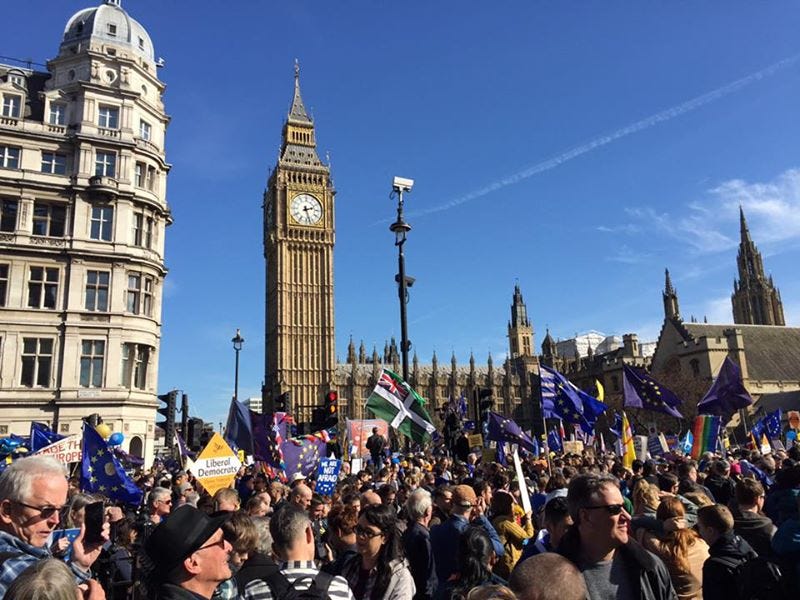
Protest in this form - like the reaction to AfD’s recent success - is partly a contest over who can best claim to represent the moral identity of the society itself, rather than just a contest over which policies should be pursued. Things like your political opponents winning electorally represent an identity threatening event, against which it is somewhat calming to gain some social reassurance. When us Remainers lost the EU referendum we didn’t just lose a policy argument. That vote appeared to say something disturbing about what sort of country Britain was and many of us voiced a sentiment along the lines of this turns out not to be the country I thought I lived in.
I roll my eyes at this now, but the feelings were intense at the time.
These days I’m more sceptical about the moral legitimacy of protest like that. This is because I’m no longer so keen to treat a democratic result as somehow illegitimate because the wrong people produced it. We often hear about ‘losers consent’ as a pillar of democracy and presenting yourselves as the only constituency entitled to define what a country or a radio station (or whatever) is or should be seems somewhat entitled and dismissive of other perspectives.
The psychological fallout from seeing your values as culturally normative but then rejected by a majority of other people really is disorienting, though. Getting together with people from your own cultural milieu papers over that rupture very pleasantly and I think this is a big part of many types of protest - both online and kinetic.
But the feeling that your values are somehow normal, whereas abnormal values are starting to become popular, is a very unwise way of navigating the world because until it’s frozen in aspic you’re going to be in for some nasty shocks from time to time, realising that not everyone else agrees with what’s normal.
All of this is why I think that many protests seem either devoid of a concrete demand, or seem unreasonable (as I think, in the case of going on strike when a show presenter from the wrong side of the tracks joins your radio station). It’s probably not really a difference between right and left. It’s probably just what happens when the status quo is challenged and people struggle to adjust to the fact that there are other people, with other ideas, in the world.
None of this is to criticise the anti-AfD protesters. Only a moron would fail to acknowledge that there are plenty of good faith reasons to be wary of that party in its current form. It’s just to say that I see that kind of protest as more comforting under identity threat than anything else.
As for the strike at Radio France, I think that’s ridiculous. Charles Sapin wasn’t even given the chance to say something on air to which they would object. He was just not one of us. To give Radio France their due, they argued that they
