



Prelude:
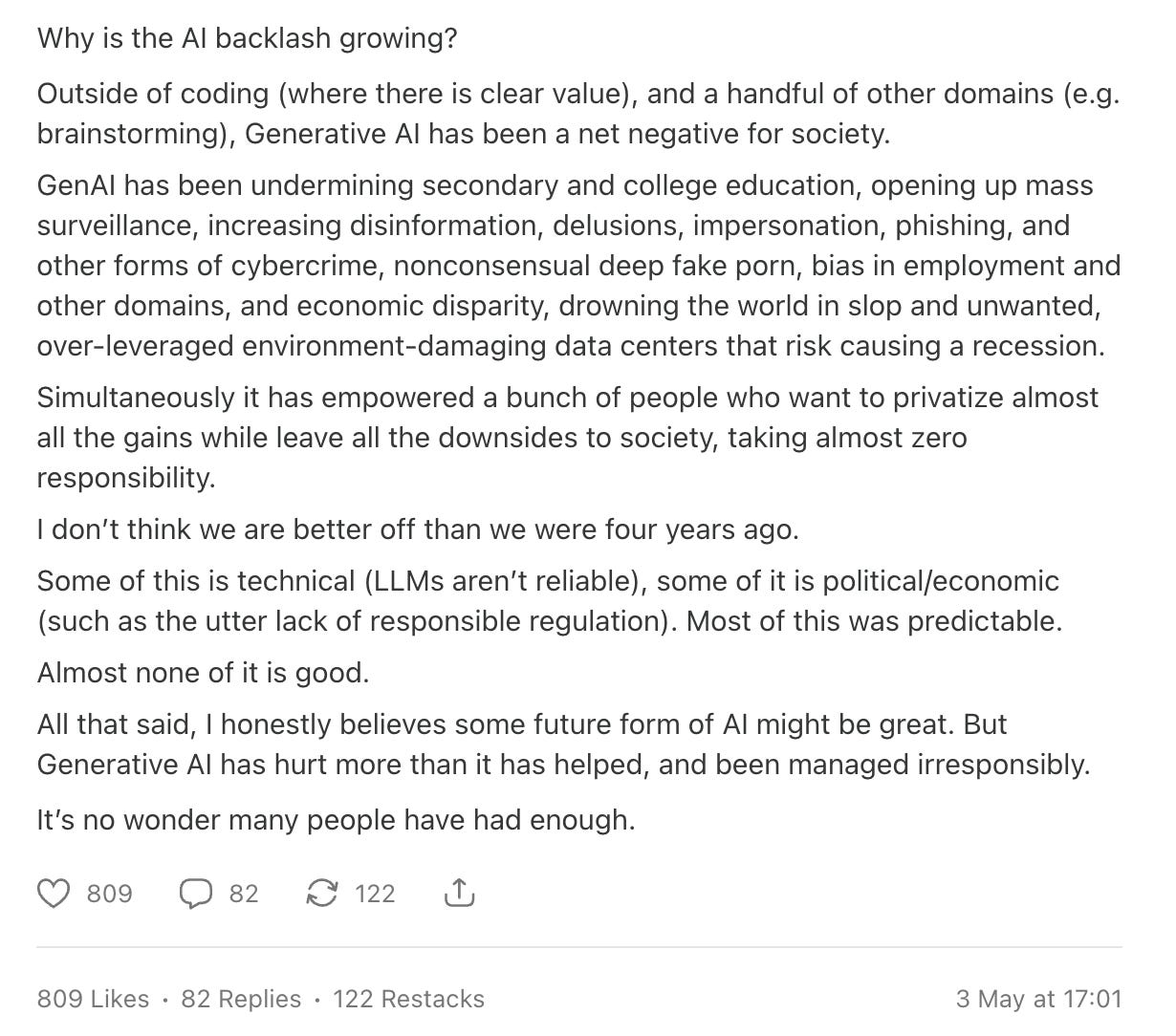
The bio of the person who posted that virally popular Note says they’re a ‘Scientist, author and entrepreneur, known as a leading voice in AI’ and mentions the externally bestowed credential of ‘NYU Professor Emeritus’. They have over 100,000 Substack subscribers.
I think this person is probably mostly posturing for a certain class of audience; those who know little about AI, feel generalised anxiety about it and wish to seem well-informed by a particular type of expert. They appear to me to be the kind of expert who has learned that flattening complex issues flatters an audience by producing a settled moral view people can easily assimilate as their own.
It’s a perfect business model. It reinforces a problem that people like this created. They profit - reputationally and financially - from the worries of those who could be benefitting from a useful new technology. In this way, they preserve their status by encouraging others to remain one step behind on the curve.
—
Anxious non-experts take considerable time to update their beliefs when new evidence contradicts their received assumptions because negative information is just stickier in the mind. So the kinds of message reproduced up top will doubtless continue to attract new followers who are glad of the reinforcement it provides for their low-information intuitions.
For example, it’s remarkable that we still hear people talking about a false statistic on water use per AI query, compared with Google search, even though the person who made that erroneous estimate has now (to their credit !) walked it back.
I’m not an AI expert - just a regular user in many domains - but the improvements it has brought to my life gives the background noise about AI an irritating quality that I can’t ignore. Which is why I write so often on the subject.
---
Last weekend I spent 15 minutes admiring an ancient beech. The tree caught my eye due to various hollows in the trunk which catapulted me back to childhood and stories of elves. Here it is.

I was 2 hours into exploring old tracks in deepest Normandy on a lovely mild afternoon. ‘Touching grass’, as escaping the machine world of screens came to be known. Much of my thinking time is during such wanders and lately I’ve realised that the screen in my pocket distracts me much less these days.
Such is the confidence with which ‘public intellectuals’ pronounce on their pet issues that for a long time I was an unquestioning recruit to the ‘phones are bad’ club. It’s natural to feel this way when you see the extent to which many people in cities especially seem glued to their screens and we all know the sense of playing second fiddle to someone’s phone, even in one-to-one interactions. I even briefly attempted to ‘detox’ from mine on walks by switching to airline mode so that I still had the option of capturing photographs but couldn’t use it for anything else.
I strongly disliked those days when I felt compelled to remain engaged in WhatsApp exchanges or feel that I must immediately consult some website or other, allowing the immediate world to slip into the background. But it was hopeless. The curious mind demands answers and so that experiment lasted about two weeks.
These days I still dislike screens in that context and I use mine substantially less, because I have been liberated by AI. This is a story that bears explaining because it’s thanks to ChatGPT that I now enjoy walks more than at any previous time in my life.
What was happening beneath that beech was my curiosity and appreciation deepening for the environment I was in. And suddenly the penny dropped. No longer was I distracted by technology in this context. Technology was substantially augmenting my experience.
Key to this is the way I use AI in general and ChatGPT in particular. There’s a dedicated chat thread in my app called ‘Nature chat’. It’s where I request background on what I’m seeing or wondering about and because everything takes place in the audio realm, my eyes and attention remain rooted in the environment rather than peering at pixels. Inevitably, the metaphor of a knowledgeable companion comes to mind. Just one that I can summon at whim and therefore enjoy my preferred mode of walking in solitude most of the time.
Now, when I look back on certain walks they are more vivid because I also remember so much more than just my movements through the landscape. It is as if the landscape became more meaningful. This contrasts quite starkly with times when I wondered what was going on with this group of birds, that unusual stand of foxgloves, an unexpectedly industrial-looking building in the middle of nowhere and would either start the wrinkly process of going on Google to mostly sift through unfocused information - or, more often than not, just forget about it.
And my information gathering is happening in a more human way than it was when my nose was stuck into the black mirror of a Samsung S22, trying to avoid the sun’s glare and generally feeling distracted from the moment even while I attempted to gain greater appreciation for it. I speak to Chatters and then play the response back in audio. At a stroke, screen use reduced by probably 95+%.
I select the example of AI-assisted life in nature from the myriad other ways that chatbots help me to operate more effectively in multiple domains because of its ironic quality. The most advanced tech in human history is rooting me more firmly in my biological essence. My tireless and knowledgeable machine companion is liberating me from technological distraction.
AI helped you appreciate a tree? That’s your pro-AI argument?
The beech story is just a minor example of what’s always missing from the conversation about AI, as currently led by a certain class of public intellectual, be they a prominent blogger/author or a ‘serious scientist’ of some kind. There is untrammelled good that arises from discerning use of a device containing this technology, but now chatbots and the screens through which we interact with them have a bad name among the bien pensants of social intellectual life.
Reputations are being carved out by overlooking and discounting even the possibility, let alone desirability, of exercising personal agency and responsibility. Reputations are more easily made by positioning us as helpless subjects of evil capitalist tech overlords. Like so many things in modern intellectual culture it reminds me of religion. But instead of priests portraying us as relentlessly influenced by the Devil and lighting the way to our salvation (by doing what they say) it’s influencers, who come under the general heading of ‘public intellectual’.
Look ... THEY made this thing ... see how much harm it’s doing.
They do this because that’s what currently sells to an anxious, neurotic audience, vigilant to every threat they just learned about from the NYT or the Guardian.
It’s both intellectually and morally thin. But it’s also unawarely hypocritical.
That’s because, at its root, this anti-tech discourse is ironically anti-human. It frames us as the machines. We’re positioned as passive victims of digital services and the devices they’re served through in ways that discount our capacity for agency, intentionality and responsibility. It’s insulting because we’re deemed to be morons by default, incapable of reforming our habits.
We are all more or less weak-minded, which is why so many of us are overweight, suffer from chronic life choices inertia and find it easier to go no further than diagnose the childhood traumatic response roots of our current failings, rather than actually changing our behaviours to make life better.
What would I know of others’ weaknesses?
I’m uncomfortably obsessive compulsive, if I don’t take active measures to resist such impulses. It manifests in ridiculous ways that I’ve come to hate. Inevitably it happened with my phone use. There was a compulsive quality, which is how I recognise it in others now. So I experimented, reflected, iterated and finally altered my habit of looking at it when there are more nourishing things to do. I was a bit hair shirt about that, at first. It meant depriving myself of an enjoyable stimulus; the immediate capacity to satisfy a curious mind. Then, along came ChatGPT and I found a mode of use that deepened my attention to the world around me, rather than fragmenting it and distracting myself from the pain of undistracted existence. Lol.
It wasn’t tech or AI that ‘saved’ me. I did that. This is a human tale, not a tech story. I did it because I care about my experience of woodland, edge habitats, seashore wandering or even walking around those parts of Cherbourg that are least familiar. I was as bad as anyone at being in the moment once the smartphone became ubiquitous, but that wasn’t the phone’s fault. It was just personal weakness.
But were I to follow the edicts of the AI discourse I’d still be blaming Silicon Valley for my bad habits.
This is what provokes my personal contempt for the ‘do-gooding’ nature of so much tech critique. The big players present themselves as morally serious and humanistic, yet all the while describing people as though they are kind of mechanically acted upon by devices. We’re all helpless, you see, without a ‘top voice in AI’ to warn us about the dangers of having nice, useful, helpful things.
Like the arguments about AI water and energy use, the arguments are essentially specious but sticky in media and on the social platforms.
I was part of that same culture once. In a classically Jungian sense this probably accounts for why it bugs me so much. Except that in my case it was banging on about how social media makes us tribal and badly behaved. I did very well out of that, for several years.
It’s always the same vibe.
Phones “make” us distracted. AI “makes” us lazy. Algorithms “make” us tribal. Social media “makes” us narcissistic
It’s a cheap and lazy story, though, which is why it works. Where’s the immediate reward in encouraging things like self-discipline, intention, healthy adaptation, self-awareness, anxiety culture, negative social norms and personal responsibility.
People use the latest manifestations of digital technology in all kinds of ways and of course many people end up worse off as a result, in terms of subjective wellbeing. But it’s a stretch to ignore the capacity for normal human agency and insist that everything is the fault of various tools.
This is now an unfashionable view, but the intellectual and moral failings of the miserable and anxiety-provoking popular story of what tech is doing to us has risen to the top of my pet peeves. I’m almost missing the good old days of mostly scorning Wokeness.
But there’s a new religion in town, thank goodness - or I’d have nothing new to rail against.
Note: I wrote this with my own wet brain and fair hand. Not so much because I think it’s bad to have bots writing things you pretended to author yourself but because I still think my writing is better than the weirdly spotless and frictionless text that emerges from machines but never quite lands in the mind.
Or, better still …
It is a pleasant thing to cross paths in the woods with someone you knew from the city.
This is a matter of interest to me. In my way, apart but the same from yours, I identify the locus of the value of AI in the same way I do for firearms. One's opinion is vacuous if it's moral center is outsourced.
"The most important thing to say about AI is the exact same thing that you would say about guns. “This is what it is, what I do with it, how, where, and why I use mine.”
People led to beliefs and priorities about such powerful things abdicate their own powers of judgement and critical observation. It's a self-fulfilling death march of the soul.
"Reputations are being carved out by overlooking and discounting even the possibility, let alone desirability, of exercising personal agency and responsibility."
The older I get, the more value I place on agency. It's one of the cores of what passes for moral philosophy for me: all people are created morally equal; it's immoral to abandon your own judgement; it's immoral to evade responsibility for your judgements and their consequences.
There *are* influences out there which induce us to make poor choices, and it is fair to be critical of them, and suggest that maybe we should avoid them. But they can't force us to do anything. The last step is always ours, and within our control.