


Note: ChatGPT keeps trying to encourage me to write much more sensibly than I do, but I ignore it for the most part. Where’s the fun in writing in a more responsible way than I enjoy?
A few weeks ago I suckered for some AI music. Decades of priding myself on a certain musical sophistication only to splash 10€ on a fake Latin House album on Bandcamp.
Now, here’s the thing. I was 100% fooled. I wish I could say that something felt ‘off’ about it, but I can’t. I had it on repeat for a couple of days.
The bottom-clenching payoff is that it was AI that alerted me to such poor discernment.
Thrilled with my discovery and curiosity sparked about the Norwegian ‘label’ that released this collection, I asked ChatGPT about it and was surprised and discomfited by its responses. It had no prior knowledge of ‘Master Records’ and voiced scepticism that such a label really exists. There I was, excited to have discovered an overlooked example of niche ‘organic’ music in a non-mainstream corner of the internet and my naivety suddenly exposed by ChatGPT’s dispassionate evidence that the whole thing was a deception.
In case you’re wondering, the signs were: no history at all for this ‘label’, no mention of it anywhere else and the sudden appearance of several albums of house music in various sub-genres completely out of the blue over the space of a few days. Only then, when I listened again, did it become obvious that this music had been assembled by a machine.
What was going on behind the scenes was this. I wanted there to be a boutique Norwegian label specialising in house music because Norway is the last place I’d look for latin grooves and I love quirky outliers in music. This minor personal conceit rendered me vulnerable to exploitation. In other words - I was asking for it.
It feels like a rare privilege to witness something as consequential as the emergence of AI. Not everyone gets to live when something that touches everyone - whether or not they actively use it - is evolving so fast. In the context of Rarely Certain it’s also a gift. The public conversation across legacy and independent media features all the facets of human storytelling and posturing that inspired me to start this newsletter. It’s ideal grist for the personal mill, grinding through the most confidently declared epistemic and moral certainties, vibes, underlying motivations and status-seeking I once found so fascinating about the confrontation of progressivism with conservatism.
Among the chattering classes of Substackistan, AI has since become one of those things that lends itself to totalising labels like Black Swan event or Hyperobject. Consequently, this platform is now full of people who don’t even know that GPT stands for General-Purpose Technology* confidently opining about the nature of AI, now and forever.
*Just kidding. It stands for Generative Pre-trained Transformer. Lol
This is one of the things I love about it. It’s a magnet for the least qualified to make sweeping generalisations from a place of ignorance, anxiety and fear.
There’s something in the pivotal quality of AI that seems to jack both smart and stupid brains into taking a settled position on its every facet.
Covid-19 just called. It wants all the stupid certainties on both sides we enjoyed so much in 2020 back.
I can’t think of any other phenomenon in my lifetime that made us ask what is distinctive about human beings and our wet brains. Or brought together epistemic and moral issues in such a unified way. I especially love how ruthlessly it exposes philosophical naivety, exemplified by widespread ignorance about ‘hard problem‘-related things and abject reliance on vibes.
It’s amusing that so many people claim that AI cannot - and will never - think, when there was already little agreement about what thinking actually is. I enjoy how it exposes our propensity to base strong beliefs on low-information foundations.
I love that I was fooled by someone prompting Suno or something else with some shit about conga grooves, in a way that now makes me listen more carefully. That lesson was worth the 10 bucks squandered on something I no longer want to play.
Being a not very nice person, I appreciate how AI gives me new targets to scorn and more opportunity to pride myself on having my own writing style.
Although I use it for myriad things in everyday life, I don’t write for clients - or for readers here - with LLMs and I scorn those who present machine-authored text as their own. I scorn their enthusiastic readers even more. This tells me something about my own ego and sense of status as someone who has only ever been able to earn a living by putting ideas into words (public relations in UK automotive, if you wonder what I did after leaving journalism at the BBC).
I can also congratulate myself on being less weak and fearful than those people who drone on and on about how bad AI writing is, when really they’re just afraid of being replaced. I can (and have) invisibly unsubscribe from those who can’t be bothered writing for themselves without making a big song and dance about it, like this person, who farmed a few likes with these predictable sentiments.
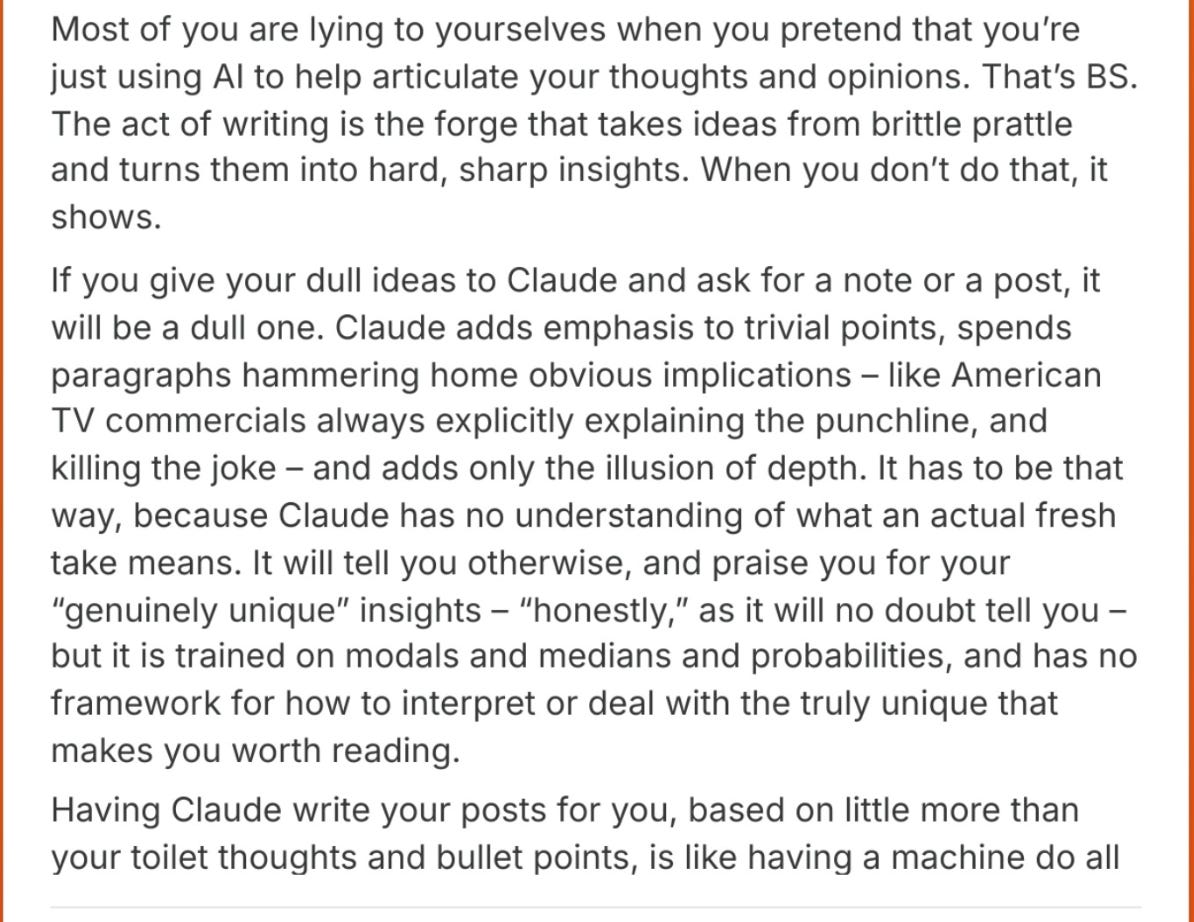
Blah blah blah - you don’t need to see the rest because it says nothing you haven’t already read thousands of times at this point. That is one of those people who confidently proclaim that all an LLM does is predict text strings and pattern-match, while doing exactly that himself.
But this is an exemplar of the standard of critique, right now, so let’s pause a moment to unpick it. Because it goes to the heart of why I write this newsletter.
He makes a whole bunch of assertions and probably believes them. But really, he’s purity signalling.
He is establishing a moral hierarchy in writing by dividing everyone who writes into two camps; real writers who suffer through the forge of writing and non-real writers who let Claude do the work.
Notice that this isn’t a practical argument about better writing but actually a claim about virtue.
There are no arguments to back up these assertions, actually.
He just says that
* Writing is the only way to refine thought.
* AI necessarily prevents thinking.
* AI cannot contribute to genuinely original insights.
* Anyone using AI extensively is deceiving themselves.
He’s simulating empirical positions while making no effort to establish them with any basis in fact.
It’s a straw man argument and we all know why people make those. It’s when they don’t really understand the issues and need to flatten them into a simplistic proposition that is easily demolished.
We doubtless agree about the horrible frictionless fluidity of Claude’s writing, but leave it there, mate. You haven’t made a case for your assertions.
You do a bit of writing, like the rest of us, but you think it’s literally a sacred process. Your virtue is apparently earned by dint of the struggle. How moral you are. What a nice story to tell yourself. Because that really is all you’re doing.
How blinkered and naive it is to think that testing and refining your ideas with a gargantuan brain like Claude’s or ChatGPT’s is cheating. What does he think libraries are for?
If someone spends ten hours producing an average essay unaided, while someone else spends two hours producing an excellent essay through a combination of thinking, AI dialogue and revision, what have you got? An average essay and an excellent one. I know which one I’m going to prefer. Especially if they at least removed the em-dashes.
If you struggled to write your essay unaided and I think I’ve learned something from it, thank you. I don’t care about your struggle. I care about what you produced. The map is not the territory and the value in your writing is not the process. It’s the result.
But it’s the arrogance and irony that gets me every time, with this kind of sentiment.
“Claude has no framework for how to interpret or deal with the truly unique that makes you worth reading.”
Really? How does he know that? I would stake everything I own on this person knowing jack shit about the internal capabilities of a system whose mechanisms are only partly understood even by the people who build it.
I wonder what that guy thinks about, say, the virtue of buying a cupboard from IKEA rather than growing the timber, felling it, seasoning it ... you know where this is going.
These moral assertions about the virtue of suffering have a quasi-religious quality, don’t they.
It’s not often you hear me making the case for people who were dealt a bad hand in life, so make the most of this, because I also disdain gatekeeping except by those who have really earned the right to police the drawbridge to their special world.
Historically, if you were dyslexic, struggled with expressing your thoughts, weren’t a native speaker in the language you wanted to publish in, or simply think better verbally than on the page, your ideas didn’t make it into the mainstream. This seems worse to me than having to tolerate people using LLMs when they really don’t need to. And if someone had a genuinely interesting insight but needed AI to express it clearly, why would that invalidate the insight?
Philosophy, eh. It’s a bitch. Which is why most people don’t really do it.
The problem with all these totalising opinions about the validity of AI inputs into someone’s work is that they’re essentially elitist views that often emanate from those who really haven’t earned an elite place in the thinking and writing firmament.
None of this is to say that the availability of tools that cut the effort involved in starting a Substack or publishing anywhere is never a problem, but the variable that really matters is the quality of the ideas. And, although the detractors seem unable to notice, AI has good ones. They’re at least as good as most people’s.
I can’t shake the sense, reading all these anti-AI takes, that for just about ever, eloquent writing was one of the markers of being an intellectual. Many people take on the identity of ‘intellectual’ in a culture that particularly celebrates ‘knowledge work’. So, when AI started to democratise the ability to publish something worthwhile it made a scarce skill less special. This is why authenticity is becoming the marker of value. How else do they retain a sense of themselves as intellectuals? If they’d been painters 200 years ago they’d have been saying the same thing about photography and we all know how photography didn’t destroy the art of painting.
Obviously, AI can obscure the true qualities - or lack of such - of the mind behind a byline, but it can also reveal minds that previously remained in obscurity. What’s wrong with that?
The reason that all of this irritates me so much is that rhetorical posturing is substituting for substantial argument and it’s coming from a place of insecurity caused by replacement fear and lack of imagination.
Just as with politics, facts matter less than feelings and arguments are assembled in service of intuitions that are mostly self-serving.
These are the same human motivations that caused people who didn’t like being told what to do in 2020 to deny the seriousness of a virus that killed millions of people. Or lead to people denying any kind of reality that inconveniences them.
They think themselves so superior, when they’re really just the same as everyone having feelings and trying to justify them by appeals to reason and ethics.
I suppose that what most irks me about the standard of commentary around AI is ultimately that I scorn those who don’t recognise their own motivations. If people were to say ‘I hate that anyone can now start a Substack and get more subscribers than me because they can fake having something to say by using Claude’ I’d laugh and broadly agree, because I hate it too.
But they don’t say that. They preen and posture over authenticity and virtue and that’s where they lose me. That kind of shit always does.
Wow. That was good. I feel I need to respond to the ability of my AI "App" to help me 1) It keeps track of my calender and to do's. It does a better job than i do of keeping track of my bounced emails and texts. 2) I'm an engineer and I had all the problems of growing up that people summarized with the phrase "He's all boy." I didn't read till 4th grade and in 5th grade my mother spent an hour and a half in our living room trying to teach me how to spell the word "mountain". The pain and frustration are still with me. But I had something to say. My 11th grade English teache loved my story of being sick in Savilie during holey week. But she corrected grammer and spelling pretty much to the extent that Chat GPT would. She told me to major in Engineering and had a great live doing DOGE before it was cool.
When I retired I was asked to help a conference on poverty get their arms around immigration and I wrote a book with the help of the Public Health Nurse. The Story of Kennett; Shaping the future on child at a time. I used a good editor to make my proes readable and then wrote articles for the Daily Local News that also had an editor for me.
3) We are moving into a Quaker retirement community in Kennett Square and we have a house full of very valuable furniture. Just joking. I have my mother's inheritance from her father an Ohio State Professor. Litterally a George Washington Cherry desk bought in Valley Forge PA for $5,000 in 1955. When she died in 1989 it was appraised for $24,000 and today because of IKEA we would be lucky to get the original $5,000 back and it should be worth over $100,000. My Dad bought a Mercedes SL sports car in '62 for about $12,000 and today it's worth over a million dollars. We have about 5 other pieces of beautiful antique funiture with all the human qurks that IKEA doesn't have, that are worth less than the Philadelphia Desk. That speaks to your original thinking that AI is never better.
Alan Turing was right and his test could include music, I can see why it made you angry to be fooled but it gave you a few days of happiness. It makes me angry because I believe that music is the only proof of God and if AI can make Bach type music that I can't tell the difference from I may have to rething my value for spirituality. I'm not sure I will ever show you the respect to write a response and then have AI upgrade it like a good proof reader would because there just isn't time in the day. But you are write that I used to write and rewrite stuff till I felt I got it write and now I tend to put down my thoughts and walk away from them without thinking them through more thoroughly.
A great post, thank you.
Bob